Last Friday, several staff members from Austin (and teachers from all over Coppell) were able to take part in a half day of professional learning withEric Jensen(of Teaching With Poverty In Mind fame). Check out this quick video for a brief overview of what Jensen speaks about.
One of the things that stuck in my mind and kept popping up later was something that he said about our role as teachers."Kids no longer need us for our content. Google replaced us there years ago."I think that really struck home to what we are trying to do now as 21st century teachers.
No longer will it suffice for us to teach our students "something" and then test them on it. Chances are, that "something" is readily available already at the click of a button. Instead, our focus should be on the skills and talents that will help them be successful in a global setting.
What were some other "take-aways" that some of you left with?
This is a first for PD@Austin! We are pleased to feature our debut Guest Blogger. I'm thinking she deserves at least a t-shirt or coffee mug for this prestigious honor. Her name is Sarah Daugherty (a member of the iTeam), and she recently returned from the Texas Computer Educators Association (TCEA) Conference in Austin. We are excited for her to share some of her learning with Austin teachers! Take a look at what is in store...
I’ve had the opportunity to attend the Texas Computer Educators Association (TCEA) for the past four years.TCEA is the statewide gathering of teachers, principals, educational technicians, and instructional technology specialists.We attend keynote presentations and break out sessions facilitated by classroom teachers and specialists.These sessions introduce new ideas in the world of instructional technology.There is a lot of “geeking out” and even more networking that goes on in every corner of the Austin Convention Center.I even had the chance to meet several Twitter “rock stars” and made potentially revolutionary connections with individuals from all over the state!
Every year I walk away with exciting ideas, tips, and tricks to share with teachers.This year was no exception.I had the chance to attend Apple Academy, an all day workshop put on by the Educational Support Representatives from Apple.
We learned about management of iDevices, great apps for every subject area, and even how to rotate apps in and out of devices so nothing gets stale!iDevices in the classroom has been around for some time, but it is a fluid movement.Resources and tools evolve daily and I’m thrilled Austin Elementary is a part of the iRevolution!
My mind was sufficiently blown within the first 15 minutes of the workshop.The rest of the day didn’t disappoint either!In fact, I started my first professional blog during a break because I was so excited about all I was learning.I invite you to follow my blog as I highlight specific apps on our campus, as well as ideas for implementing apps to coincide with the instructional vision of grade-level curriculum.
Sarah Daugherty is an Instructional Technology Specialist for Austin and Mockingbird Elementary.She has been in CISD for 10 years and served on the iTeam for four of those years.If she was not in education, Sarah would work for E! News, taking at least one of Ryan Seacrest’s jobs.
Sarah, here is your Techie coffee mug for being featured on our blog.
We finished up the second half of our session on Question Strategies with Todd Kettler yesterday afternoon. Topics included a comparison between Kramer (from Seinfeld) and a cell nucleus and choosing between living life as a fraction or a decimal. Let's just say, "I guess you would have had to have been there."
We also continued our discussion of divergent questioning. Our ultimate goal with questioning is for our students to generate ideas. With divergent questions, we learned, you are able to spark/generate ideas while at the same time check for understanding (generally accomplished through basic convergent questions).
One of the things I'm still thinking about is the frequently cited observation that "students come into Kindergarten asking tons of questions but leave high school with no questions at all." What is happening in the middle? What are we doing to kids to stifle their curiosity and their instinct to generate questions/ideas?
Yesterday afternoon, we began the first part of a two part training on Questioning Strategies with our district Director of Advanced Academics Todd Kettler. To say the least, the frequency and depth of a teacher's questioning during instruction can have a great effect on student learning! A couple of stats to think about-
40% of our instructional time is spent questioning.
75-80% of questioning in elementary is at the memory/recall level.
We then began a discussion on Convergent vs. Divergent questioning. Todd described Convergent questioning as generally having one possible response (doesn't stimulate critical thinking, not very engaging, designed to check for understanding). Divergent questioning, on the other hand, allows teachers to check for understanding while at the same time promoting critical thinking AND stimulating student-generated questions. Of course, Divergent questioning is what we should strive for, but more often than not we focus on the knowledge-based Convergent questioning. This sparked a great question from one of our teachers-
If students aren't successful with the Convergent questions (that is, if they can't correctly answer the recall/memory/low-level questions), is it instructionally appropriate to move on to more critical, deeper Divergent questions?
That's a tough question to answer! Thoughts? If you agree that it is appropriate, how do you asked those higher-level questions without that basic knowledge? Hopefully, these are some questions that we'll be able to pursue when we meet again.
This past Monday, Austin staff members received the book Mindset. We will spend the next few months looking at it in-depth through a campus-wide book study. Here is an overview provided by the book's website:
In a fixed mindset, people believe their basic qualities, like their intelligence or talent, are simply fixed traits. They spend their time documenting their intelligence or talent instead of developing them. They also believe that talent alone creates success—without effort. They’re wrong.
In a growth mindset, people believe that their most basic abilities can be developed through dedication and hard work—brains and talent are just the starting point. This view creates a love of learning and a resilience that is essential for great accomplishment. Virtually all great people have had these qualities.
Teaching a growth mindset creates motivation and productivity in the worlds of business, education, and sports. It enhances relationships. When you read Mindset, you’ll see how.
Wow! Yesterday's professional learning on "Connectors" was a day of A-HAs and Hmmms. Check out this video of an activity that got us to thinking about how we are connected as a campus and how everything that we do (our Output) affects others (their Input).
(Hey, don't laugh! It's harder than it looks!)
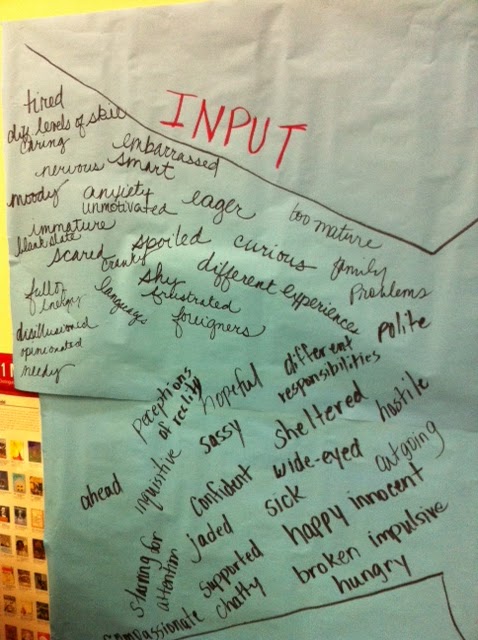
In an overly simplified nutshell, "Connectors" introduced us to the idea that every student and staff member is connected at Austin Elementary, and every word, action, and deed has an impact on our learning community. Take a look at the connector below (we named her "Mustang Sally").
The left side of the Connector, or theInput, illustrates what comes to us; students that are smart, eager, tired, gifted, troubled, innocent, nervous, etc. See below...
The right side of the Connector, or the Output, shows how we want students to leave Austin Elementary; students that are encouraged, aware, passionate, happy, creative, playful, independent, etc. See below...
As "Connectors" taught us, what helps us make the transition from our Input to our Output are the Transforms (generally verbs) that we do to "transform" our Input to our Output. Still with me? Some of our Transforms were: laugh, provide, share, challenge, discipline, celebrate, empower, enrich, motivate, model, teach, correct, etc. See below...
From there, we began to discuss how within the Austin Elementary Connector (Mustang Sally) there are individual Connectors and even grade level Connectors that, when aligned properly, build toward the desired Output of Mustang Sally. Now I'm sure I've lost a few people.
Below are pictures of some of the aligning we did with our grade level content-specific Connectors.
Our final Mustang Sally (with the grade level Connectors inside) has been posted and will be used to facilitate discussions of content alignment and vision alignment.
We sucessfully completed our first session of E-Time! I think we were all a bit nervous, but things went smoothly. After all, this was a first for each of us.
Our teachers did an excellent job of introducing the concept of "enrichment." We frequently overheard words such as passion, discovery, interest, and choice. Students were excited to "take the wheel" in their own learning.
After the concept of enrichment was introduced and E-Time was defined more clearly, students had a chance to spend some time on activities that matched their interests.
Check out the video below for a quick "recap" of the morning! For more info about the Schoolwide Enrichment Model @ Austin Elementary, check out Lifelong Learning Made SEMple and follow us on Twitter with #AustinSEM .